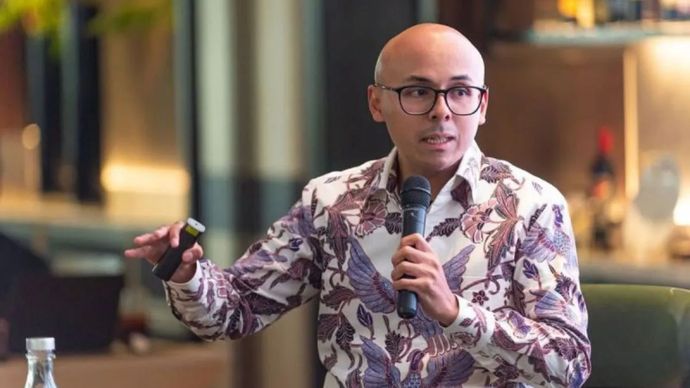
 Dirgayuza Setiawan (Antara)
Ntvnews.id, Jakarta - President Sukarno’s bookshelf now placed at Istana Bogor is not simply a collection of old books — they are an intellectual blueprint of the ideas that informed the founding of modern Indonesia and the worldview of one of the twentieth century’s most influential leaders.
The books that President Sukarno reads offers an extraordinary glimpse into the intellectual foundations of Indonesia’s founding father.
More than a personal collection, it reflects a lifelong effort to understand how civilizations rise, nations are built, revolutions succeed, and leaders shape history.
The collection spans politics, history, economics, sociology, religion, philosophy, engineering, architecture, military affairs, agriculture, and comparative civilization. Written in English, Dutch, German, French, and Indonesian, most of the books were published between the 1920s and the early 1960s, with a number of influential nineteenth-century classics
One of the strongest themes in his collection is nation-building and anti-colonialism. George McTurnan Kahin’s Nationalism and Revolution in Indonesia (1952), Dorothy Woodman’s The Republic of Indonesia (1955), Jawaharlal Nehru’s The Discovery of India (1946), Karl W. Deutsch’s Nationalism and Social Communication (1953), Tang Leang-li’s The Foundation of Modern China (1945), and Harold R. Isaacs’ No Peace for Asia (1947) demonstrate Sukarno’s determination to study Indonesia alongside the wider decolonization of Asia.
The shelves also reveal an unusually broad engagement with political thought across the ideological spectrum.
Sukarno owned Niccolò Machiavelli’s Discourses on Livy (early twentieth-century edition), George H. Sabine’s A History of Political Theory (1937), Bertrand Russell’s Roads to Freedom (1918), Vladimir Lenin’s Selected Works (Foreign Languages editions of the 1950s), Mao Zedong’s Selected Works of Mao Tse-tung (1954–1955), Henriette Roland Holst’s Rosa Luxemburg (1935), C. H. Binkley’s Realism and Nationalism, 1852–1871 (1935), and Frederick B. Artz’s Reaction and Revolution, 1814–1832 (1934), suggesting that he sought to understand competing schools of political thought rather than confine himself to one ideology.
Religion and civilization occupy another major section of the collection. Lin Yutang’s The Importance of Living (1937), Syed Ameer Ali’s The Spirit of Islam (1891), Carl Brockelmann’s Geschichte der islamischen Völker (History of the Islamic Peoples, 1939), Romain Rolland’s The Life of Ramakrishna (1929) and Mahatma Gandhi (1924), The Ramayana of Tulsidas, and several volumes of The Complete Works of Swami Vivekananda (early twentieth-century editions) reveal Sukarno’s deep interest in the spiritual and cultural traditions that shaped Asia.
World history and international relations are equally well represented. Charles Oman’s The Shorter Cambridge Medieval History, edited by C. W. Previté-Orton (1934), Kenneth Scott Latourette’s A Short History of the Far East (1946), Kenneth Scott Latourette’s Advance Through Storm (1940), R. R. Palmer and Joel Colton’s A History of the Modern World (1950), Edward R. Stettinius Jr.‘s Roosevelt and the Russians: The Yalta Conference (1949), Winston Churchill’s The Sinews of Peace (1948), Sir Richard Winstedt’s Malaya and Its History (1948), and Harold Lamb’s The March of the Barbarians (1940) indicate that Sukarno viewed Indonesia’s future through the broader lens of world history and diplomacy.
A notable feature of the library is the large number of Dutch-language scholarly works on Indonesia and Southeast Asia. Even after independence, Sukarno continued to consult Dutch, German, and French scholarship because much of the most comprehensive academic research on Indonesia was still being produced in Europe.
For me, the collection is remarkable not because it promotes a single worldview, but because it brings together opposing ones.
Some of the quotes in the books on Sukarno’s bookshelf includes:
“The safety of a republic or a kingdom is not preserved by the observance of good faith, but by prudent foresight.” - Discourses on Livy by Niccolò Machiavelli (1517; Sukarno’s edition published early 20th century).
“A nation is a people who have learned to communicate effectively with each other.” - Nationalism and Social Communication by Karl W. Deutsch (1953).
“The Indonesian Revolution was essentially a revolution of ideas.” - Nationalism and Revolution in Indonesia by George McTurnan Kahin (1952).
“The good life is one inspired by love and guided by knowledge.” - Roads to Freedom by Bertrand Russell (1918).
“The empires of the future are the empires of the mind.” - The Sinews of Peace by Winston Churchill (1948).
“Islam came to restore the dignity of man.” - The Spirit of Islam by Syed Ameer Ali (1891).
For me, as special assistant to the 8th President, perhaps the most striking similarity between Prabowo’s library and Sukarno’s library is not that they contain the same books, but that they were built around the same questions.
Both collections place nation-building, history, political theory, military affairs, Asian civilizations, religion, and world affairs at their core, while drawing on an unusually broad range of intellectual traditions — from Machiavelli, Churchill, and Nehru to Lenin, Mao, and Islamic scholarship.
Neither library reflects an attachment to a single ideology; instead, both reveal leaders who read widely across competing schools of thought in search of practical lessons on leadership, statecraft, and national transformation.
If Sukarno’s library reflects the intellectual journey of the leader who founded the Republic, Prabowo’s library reflects that of a leader seeking to strengthen and transform it, making the two collections remarkably similar in their breadth, historical orientation, and enduring preoccupation with how nations become strong, sovereign, and prosperous.
Dirgayuza, Special Assistant to the 8th President of Indonesia. Note written on July 3, 2026. A separate note will be written in the near future on Prabowo’s collection.
 Ikuti Whatsapp Channel NTVNEWS.ID